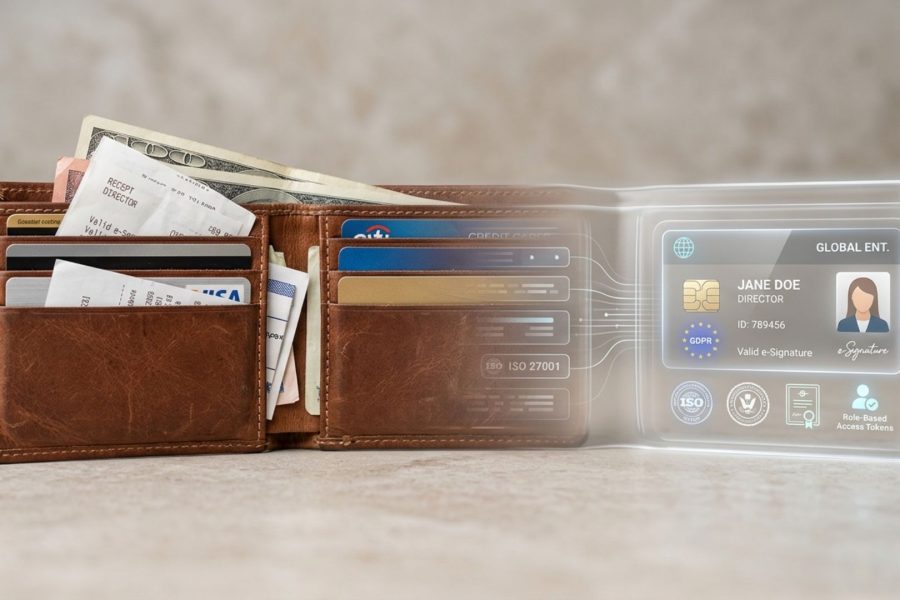
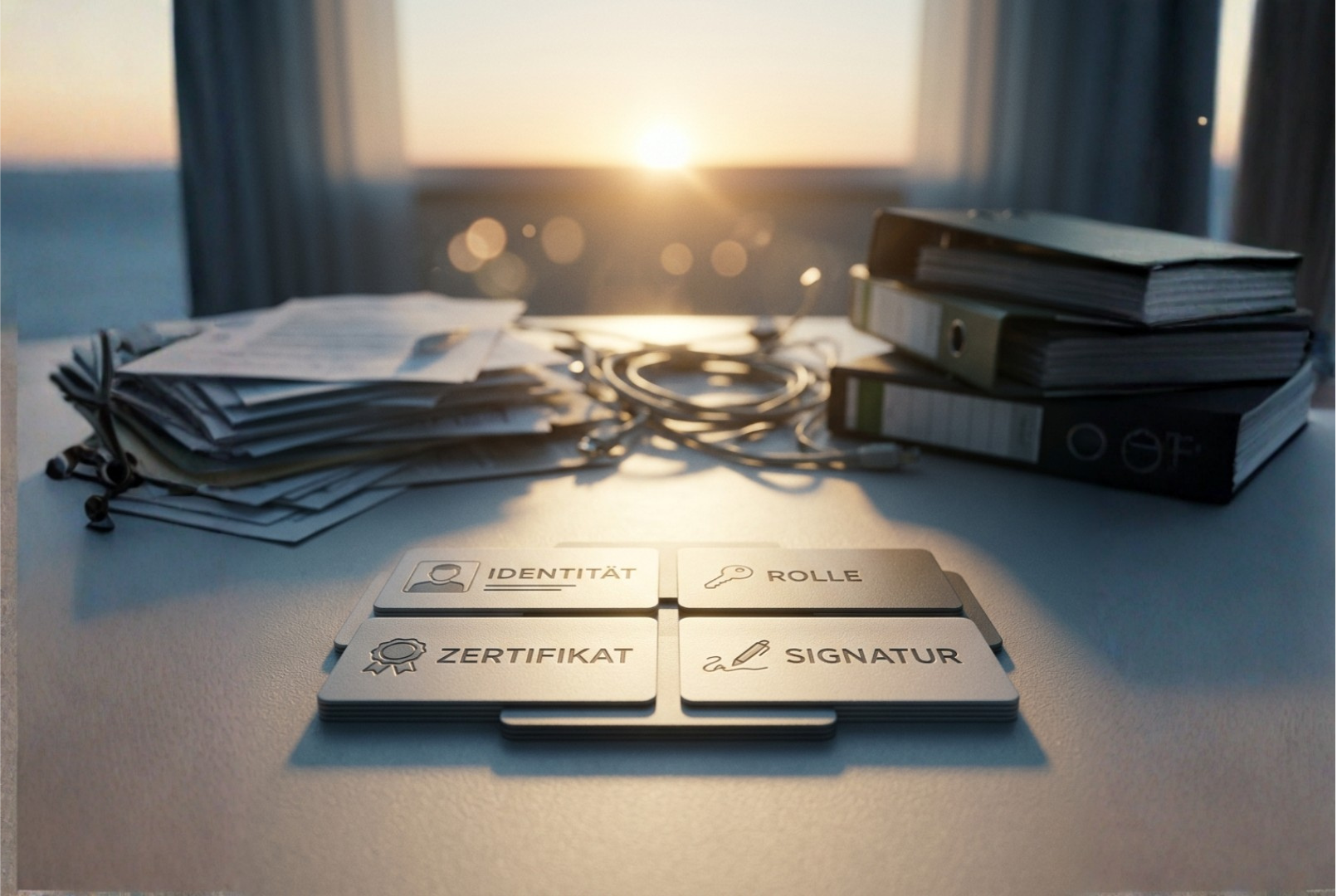
Digital identity may sound grand and perhaps a bit abstract at first. In practice, however, it’s much more tangible than the term suggests. After all, it’s not about simply having some digital profile. It’s about being able to reliably prove who someone is, in what context a person or organization is acting, and what they are authorized to do – all through digital identity in a specific process.
In a business context, a digital identity is not just a login. It refers to the digital overall picture of a person or organization: the information and evidence that reliably show who someone is and what they are allowed to do. It is thus the digital answer to the question: How can my counterpart reliably recognize who I am or what I am authorized to do?
This can look quite different. A person can, for example, prove that they belong to a certain company, have a specific role there, or are authorized to initiate a process, approve a document, or sign an application. A digital identity thus does not consist of a single entry but of several pieces of information and confirmed characteristics that together form a coherent picture.
This is precisely why it is more than just access to a system. In many processes, it is not enough for someone to simply log in somewhere. What matters is that certain information can also be reliably verified, such as the identity itself, a role in the company, or a specific authorization.
Why digital identity cannot do without evidence
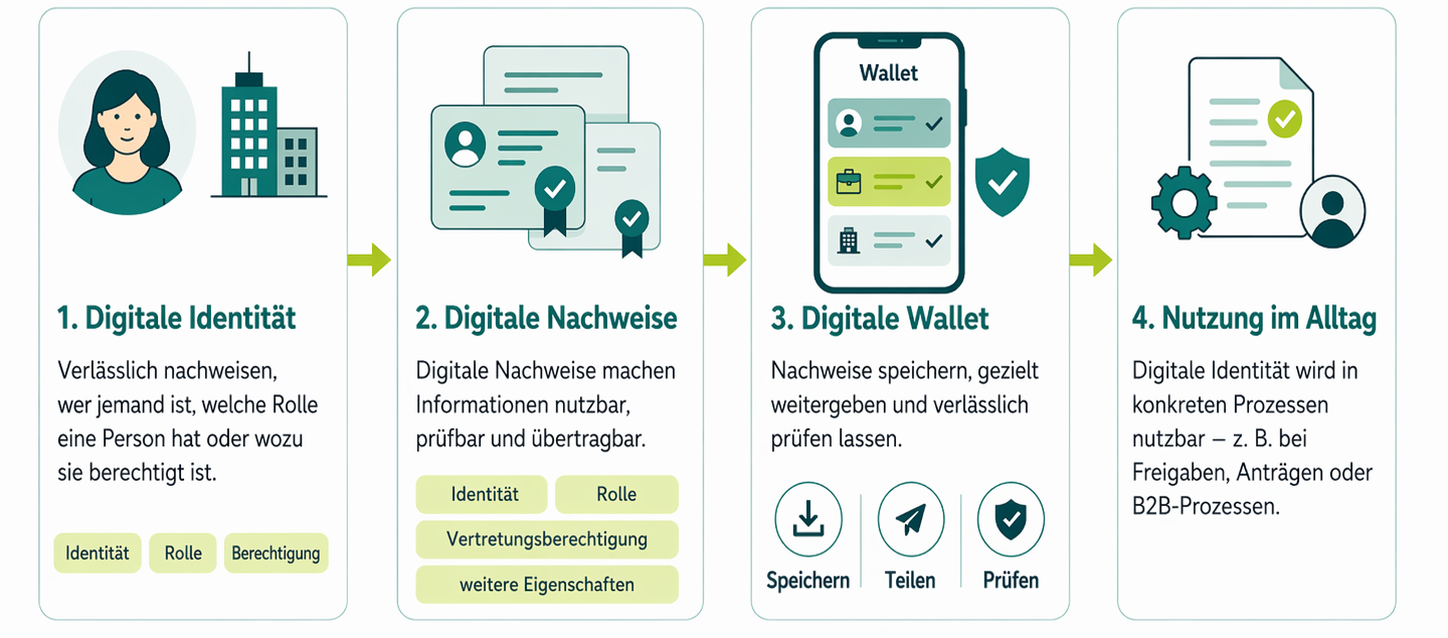
For digital identity to work in practice, it must be possible to specifically prove and use it at the right moment. This is precisely where digital evidence comes into play. It makes information about people or companies usable, verifiable, and selectively shareable. This includes, for example, identity data, roles, representation authorizations, or other relevant characteristics.
Only through such evidence does digital identity become truly useful in everyday life. In practice, hardly anyone just wants to hear that some information is stored somewhere. What matters is that it can be presented and verified at a specific moment.
This is exactly where digital wallets come into play. They are designed not only to store such evidence but also to make it specifically usable. This means: Evidence can be received, managed, presented, and verified when needed in a particular process.
In the European framework, this is also referred to as electronic evidence of attributes – characteristics that can be authenticated.
This may sound technical at first, but in everyday life, it’s quite simple. Instead of sending PDFs back and forth, saving screenshots, or manually transferring data, exactly the evidence that is needed at that moment is used.
How wallets make digital evidence usable
Basically, two types of wallets can be distinguished: the European Digital Identity Wallet, or EUDI Wallet for short, and the EUBW, the European Business Wallet. The EUDI Wallet is to be provided by member states for citizens, residents, and companies by the end of 2026. Its contents will be recognized throughout Europe. Business wallets, on the other hand, are more focused on company data, organizational evidence, and B2B processes.
We have summarized more about the use of digital wallets in the B2B environment in a separate blog post. For the basic interaction of identity, evidence, and wallets, the following graphic helps:
How digital identity works in practice
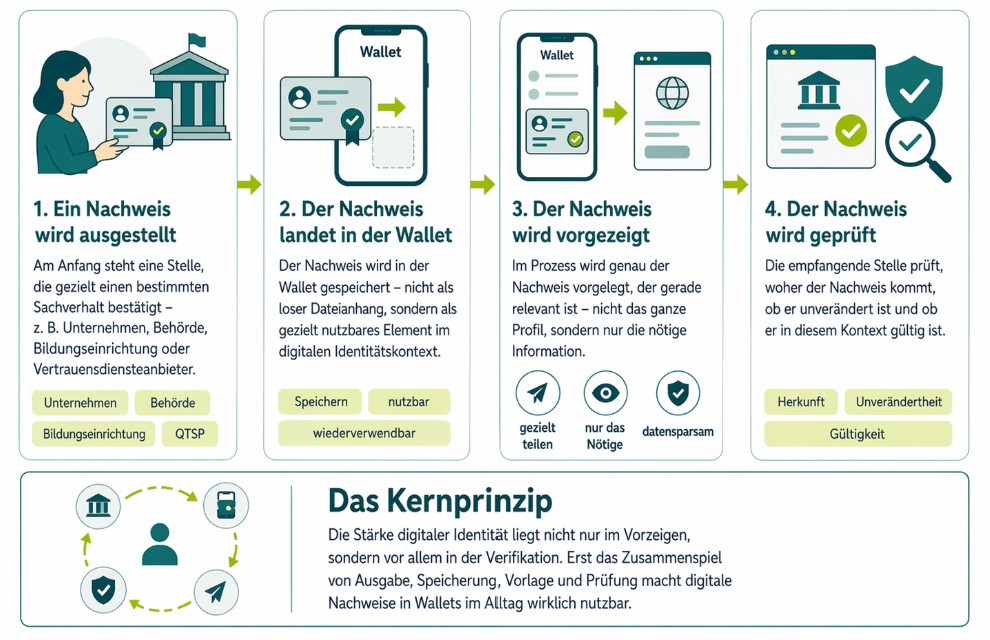
How this interaction looks in practice is best shown by the path of a digital credential in a wallet. In practice, this usually takes place in four steps.
1. A credential is issued
At the beginning, there is always an entity that can confirm something. This could be, for example, a company, an authority, an educational institution, or a qualified trust service provider. This entity does not confirm everything about a person, but very specifically a certain fact. For example: This person is an employee. This person has completed a certain training. This person has a certain role. Or: This organization actually belongs to this company.
Here, an important difference between general information and digital identity already becomes apparent. Not everything needs to be disclosed at once. Rather, it’s about providing the appropriate credential for the appropriate moment.
2. The credential is stored in the wallet
Afterwards, the credential is stored in the wallet. There, it doesn’t just lie around like an email attachment, but as a specifically usable element that can be presented again in later processes.
This is precisely what makes the difference: A wallet doesn’t just store credentials but keeps them ready so they can be used again in the right context.
3. The credential is presented
The exciting part comes when the digital identity is actually needed in the process. For example: Someone wants to prove in a digital process that they belong to a certain organization or are authorized for a specific step. Then, the entire profile doesn’t need to be disclosed. Instead, exactly the credential that is relevant at that moment is presented.
The EU also essentially describes the wallet in this sense: as a way to identify oneself digitally, store important documents, and share data securely without revealing more than necessary. You can find more about this in this article.
4. The credential is verified
On the other side, there is always an entity that needs to evaluate the credential, such as a system, portal, or company. There, it’s not enough for something to just look formally correct. It must be verifiable.
Therefore, what matters is not just that a credential is presented, but that it can also be technically verified whether it is genuine. For this, it must be traceable who issued it, whether it has remained unchanged since issuance, and whether it is still valid in the specific context. Only this interplay of issuance, storage, presentation, and verification makes digital credentials in wallets truly robust in everyday use.
Is a digital identity really trustworthy?
Precisely because many people initially approach digital identities with skepticism, the question of their trustworthiness is so important. Doubts often arise when it’s unclear where information comes from, whether it could have been altered, or whether it can be believed at all.
This is exactly where it becomes clear what really matters with digital identity. Trust doesn’t arise simply because information is available digitally. What’s crucial is whether the underlying evidence can be reliably verified. It must be traceable who issued it, whether it has remained unchanged, and whether it is valid in the respective context. Only this verifiability turns a digital statement into a robust digital identity.
Conclusion
Digital identity becomes tangible especially when it can be used in concrete processes. This is exactly what digital evidence in a wallet enables. It makes information not only digitally available but also specifically usable, verifiable, and presentable at the right moment.
What’s crucial here is that not just any data is stored, but that the origin, integrity, and validity of a credential can be reliably verified. Only this turns a digital statement into a robust digital identity.
Wallets provide the appropriate framework for this. They help securely store evidence, share it selectively, and make it usable in the respective context. This is precisely their practical added value: Digital identity is not just managed but actually usable in everyday life.
As a qualified trust service provider, we at SIGN8 can issue such digital credentials and also support companies in setting up business wallets. If you would like to learn more about how digital evidence, trust services, and wallets can be thought of together in practice, we would be happy to discuss this with you in a personal meeting.
FAQ: Digital Identity
What is a digital identity?
A digital identity includes information and evidence that reliably show who a person or organization is and what they are authorized to do.
What are digital credentials?
Digital credentials are confirmed information, for example about identity, role, qualification, or authorization to represent. They make digital identity usable in processes.
What does a digital wallet do?
A digital wallet stores credentials and enables them to be selectively shared and verified when needed.
How does a credential work in a wallet?
A credential is issued, stored in the wallet, presented at the appropriate moment, and then verified.
How can you tell if a digital credential is genuine?
What matters is whether it can be verified who issued the credential, whether it has remained unchanged, and whether it is valid in the respective context.