
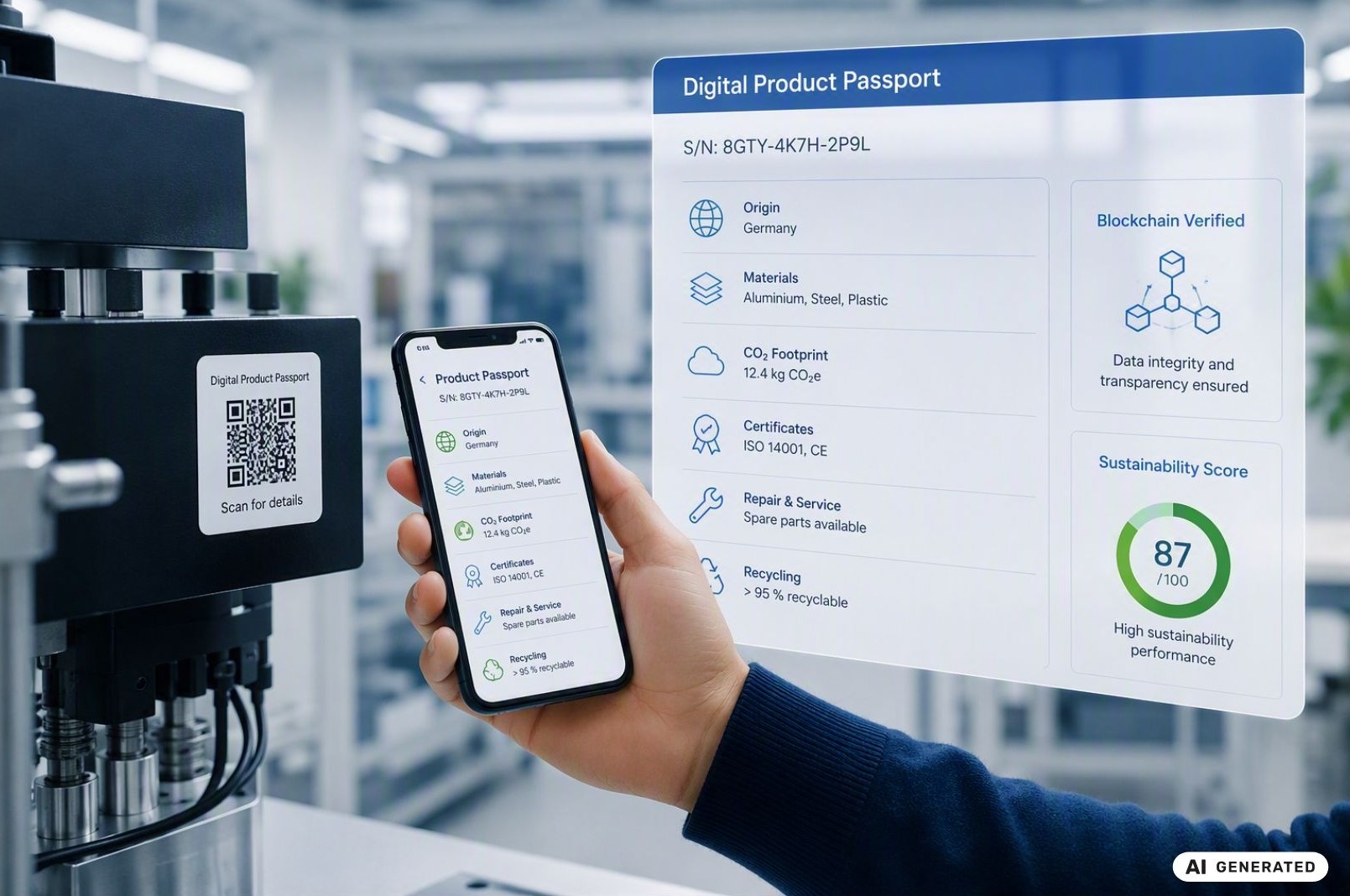
The Digital Product Passport, often referred to as DPP, denotes a new digital information framework for products in the EU. It aims to make relevant product information digitally available – such as materials, origin, repairability, lifecycle, recyclability, sustainability, and regulatory evidence. Its introduction is closely linked to European ecodesign goals and thus affects not only individual companies but, in perspective, large parts of the European economy.
For manufacturers, importers, suppliers, and those responsible for compliance, IT, product data management, and sustainability, this means: The DPP is not simply a QR code on a product. The QR code or another data carrier is merely the access point. Behind it lie structured product data, unique identifiers, registers, technical standards, and trusted digital evidence – for example, through a qualified electronic seal, or eSeal for short.
The Digital Product Passport is a digital data record for a product. It contains information relevant throughout the entire product lifecycle: from manufacturing through use, repair, and reuse to recycling or disposal.
The central legal basis is the European Ecodesign Regulation for sustainable products, known as ESPR. It provides the regulatory framework for making digital product passports mandatory for certain product groups in the future. Additional product-specific regulations, such as the Battery Regulation, already include specific requirements for a battery passport. The European Commission will gradually specify these requirements through delegated acts.
Depending on the product category, a product passport may include information on the manufacturer, materials, raw materials, energy efficiency, CO₂ footprint, spare parts, safety certificates, compliance, recyclability, and supply chain. Importantly, the Digital Product Passport is not a static PDF or a mere marketing data sheet. It is intended to make product specifications available in a structured, machine-readable, up-to-date, and reliable manner.
Why is the EU introducing the Digital Product Passport?
The EU pursues several objectives with the Digital Product Passport. At its core, it aims to increase transparency, strengthen the circular economy, and promote more sustainable products. Today, product information is often scattered across different systems: ERP, PLM, PIM, quality management, technical documentation, certificates, or suppliers. Often, this data is not uniformly structured, not complete, or not easily accessible.
This is precisely where the DPP comes in. It aims to make information more easily available along the value chain. Consumers can better recognize how sustainable or repairable a product is. Repair shops receive relevant information on spare parts or components. Recyclers can identify materials more efficiently. Authorities can more easily verify regulatory requirements.
For companies, this means: Product details are no longer needed only internally for development, production, or sales. They become a regulated digital trust asset. Those who structure their data early can reduce future compliance efforts and simultaneously unlock new potential for more efficient processes. Especially in complex industrial value chains, the DPP becomes an instrument to make responsibility, origin, and quality more traceable.
How the Digital Product Passport works in practice
In practice, the Digital Product Passport is linked to the physical product via a data carrier. This can be a QR code, an NFC tag, an RFID chip, or another machine-readable identifier. Scanning the code provides access to the respective product specifications.
However, not every stakeholder automatically sees the same data. A consumer needs different information than a market surveillance authority, a repair shop, a recycler, or a business partner. The Digital Product Passport will therefore likely work with different access rights. Public information may include origin, sustainability details, or repairability. Authorities can additionally view compliance data or technical evidence. Business partners in the supply chain, in turn, require certain specifications, certificates, or material data.
The product passport is thus not a digital label in the strict sense. It is a structured access point to trusted product information – depending on the product group, legal act, role, and authorization.
Where must companies register the Digital Product Passport, and what does the process look like?
A key question is: Where is the Digital Product Passport registered?
At the EU level, an EU DPP Registry is planned. This registry is not expected to centrally store all product information. Rather, it will register certain identifiers and reference information to ensure that products can be uniquely found and verified.
The actual product information can continue to reside in internal systems, specialized DPP platforms, or industry-specific data spaces. The EU DPP Registry will then serve as a trusted reference point within the European framework.
This distinction is important for companies. The goal is not to transfer all internal product specifications to a central EU database. What matters is that the required data sets are provided correctly, structured, up-to-date, and accessible.
The specific registration process will be further defined through technical specifications, standardization, and delegated acts. However, companies should already expect a multi-stage process. Standardization is crucial because it determines how data formats, interfaces, and access concepts will function interoperably in the future.
First, it must be clarified whether a product falls under a relevant regulation or delegated act. Then, the required data for the respective product category must be determined. Textiles require different information than batteries, electronics, construction products, or industrial intermediate products.
Next, unique identifiers must be established. Products must be reliably identifiable, for example, via model, serial, batch, or product codes. Based on this, the DPP data set is created, linked to the data carrier, and made accessible to authorized stakeholders. In the next step, the relevant reference data and identifiers are registered in the EU DPP Registry.
Typical preparation steps include:
– Analyzing affected product categories
– Reviewing existing product details, systems, and supply chain data
– Defining data responsibility, updates, and access rights
– Planning technical interfaces, data carriers, and registry integration
Another important point is the verification of company identity. When a company provides or registers product specifications, it must be traceable that this data actually originates from that company. This is where digital identities, trust services, electronic signatures, and qualified electronic seals come into play.
The role of the qualified electronic seal in the DPP
A qualified electronic seal, known as a qSeal, is a trust service under the eIDAS Regulation. While an electronic signature is assigned to a natural person, an electronic seal is assigned to a legal entity – such as a company, authority, or organization.
This is relevant for the Digital Product Passport because companies will need to prove that certain digital product information actually originates from them and has not been altered unnoticed. A qualified electronic seal can secure the origin and integrity of DPP data. Simply put, it acts like a digital company stamp with a high level of legal and technical trust.
In practice, a qSeal can play an important role in registration, the provision of compliance evidence, or the securing of machine-readable product information. Whether it will be mandatory in every DPP process depends on the specific requirements of the respective legal acts and technical specifications. Nevertheless, it is advisable for IT and compliance teams to consider seal processes early on.
Will all products need a Digital Product Passport in the future?
No, not immediately and not for all products at the same time. The Digital Product Passport will be introduced gradually. The ESPR provides the general framework, but specific obligations will arise through product-specific requirements. This introduction follows a logic that gradually combines product groups, risks, and ecodesign requirements.
The EU Commission will determine through delegated acts which product groups are affected and what data must be provided. Factors such as environmental impact, market volume, resource consumption, and circular economy potential play an important role.
Products with high environmental and resource relevance are particularly in focus. These include batteries, textiles, electronics and ICT products, furniture, construction products, plastics, metals, and certain intermediate products in industrial supply chains. A concrete pioneer is the Battery Regulation: For certain batteries, particularly industrial and electric vehicle batteries, the battery passport will become relevant starting in 2027.
Digital Product Passport: When does it apply to companies?
The question “When does the Digital Product Passport apply?” cannot be answered with a fixed date. There is no deadline by which all companies must provide a DPP for all products simultaneously.
Instead, the obligation will arise gradually. The ESPR provides the regulatory framework, while specific requirements for individual product categories will follow through delegated acts. For certain batteries, the first concrete obligations will take effect starting in 2027. Other industries and product groups will be included step by step thereafter.
For companies, this means: Even if their own product group is not immediately affected, preparation should not be postponed. Clean product data, clear responsibilities, suitable IT systems, and trusted verification processes cannot be established at short notice.
The significance of the DPP for organization, IT, and compliance
The Digital Product Passport is not just a sustainability project. It affects organization, IT, compliance, legal, product management, procurement, supply chain, and sustainability teams equally.
Compliance teams must monitor regulatory requirements and classify reporting obligations. IT must provide systems, interfaces, and data models. Product management and development must define and maintain relevant product information. Procurement and supply chain must collect data from suppliers and process it reliably. Sustainability teams need robust data for reporting, circular economy, and ESG requirements.
In practice, the DPP thus becomes a cross-functional task. Companies should clarify early on who is responsible for which data, which systems serve as the primary source, and how data quality can be ensured in the long term. Along the value chain, it will also be crucial that information is reliably passed on and updated.
How can companies manage product data efficiently?
Many companies already possess some of the required information. The challenge often lies not in the absence of data but in its scattered, inconsistent, or insufficiently validated nature.
For efficient implementation, companies should analyze their existing product data. What information is already available in ERP, PLM, PIM, or quality management systems? What data comes from suppliers? Which details are regulatory-compliant? Which information may be publicly visible, and which should only be accessible to authorities or specific stakeholders?
A good Digital Product Passport does not start with the QR code but with product data management. Key factors include clear data responsibility, traceable sources, regular updates, and technical interfaces that make product information securely and standardly available. This not only improves data quality but also enhances efficiency in internal review and approval processes.
How can the Digital Product Passport be implemented technically?
Technically, a DPP consists of several components: unique product identifiers, structured data sets, digital interfaces, a data carrier on the product, connection to registers, and, if necessary, trusted evidence through signatures, seals, or certificates.
Interoperability is crucial: The Digital Product Passport should not end up as an isolated submenu on a product website. It must be machine-readable, standardized, and usable across system boundaries. Only then can it function along European supply chains, authority processes, and circular economy models.
Companies should also consider that product information does not always remain static. Repair instructions, spare parts, software versions, recycling guidelines, or regulatory requirements may change over a product’s lifecycle. The DPP must therefore not only be created but also maintained.
These are the advantages of the Digital Product Passport
The Digital Product Passport is initially a regulatory requirement. However, it can also provide real benefits for companies. Those who structure their product data cleanly improve internal processes, reduce effort in audits and market surveillance, and create a better foundation for sustainability reports. Additionally, data-based services, spare parts processes, or take-back programs can enable new business models.
The key advantages include:
– Greater transparency about products, materials, and supply chains
– More efficient compliance, review, and verification processes
– Better foundation for repair, reuse, and recycling
– New business models and potential competitive advantages
The Digital Product Passport is therefore not just an obligation. When implemented correctly, it can become a tool for efficiency, trust, and differentiation.
Frequently Asked Questions about the Digital Product Passport
What is the Digital Product Passport simply explained?
The Digital Product Passport is a digital data record for a product. It contains information on origin, materials, sustainability, lifecycle, and compliance.
Is the Digital Product Passport mandatory across the EU?
Yes, the DPP is being introduced within the EU framework. However, the obligation will be phased in for specific product groups and not immediately for all products.
Which products are affected first?
Among the first affected areas are batteries. In the future, textiles, electronics, furniture, construction products, plastics, and resource-intensive intermediate products will also be relevant.
What role does an electronic seal play?
A qualified electronic seal can verify the origin and integrity of DPP data. It digitally confirms that information originates from a specific company and has not been altered unnoticed.
Conclusion
The Digital Product Passport will become an important building block for companies in terms of product data, sustainability, and digital compliance. Those who start early can implement requirements in a more structured way and simultaneously improve data quality, transparency, and efficiency.
For registration via the EU DPP Registry at registry.product-passport.ec.europa.eu, a qualified electronic seal is required. SIGN8 provides companies with the necessary qualified seal and supports trusted digital verification processes. Either book your Business Package directly or send us a message at customerservice@sign8.eu.